Author: David Madigan

  • Remaking Britain: A Complete Programme for Economic Reform

    Economics & Policy · May 2026

    There is £111 billion a year flowing from the public purse to banks, overseas investors and the already-wealthy. That money was earned by ordinary people. It could be building something. Here is how.

    I want to start with a number. £111 billion. That is what the British government paid in debt interest last year — more than the entire schools budget. Around £50 billion went to financial institutions. Another £37 billion left the country entirely. The wealthiest 10% of people pocketed roughly £48 billion from government bonds alone. The bottom 70% got almost nothing.

    I’m an engineer. When something this large is going this wrong, my instinct is to ask what’s actually causing it — and whether it can be fixed. I think it can. What follows is my attempt to trace a complete programme of reform: not picking at symptoms, but going after the root causes in the right order, with honest assessments of where it’s hard and what the resistance will look like.

    This is a long piece. The problem deserves the length.

    The Root Cause Nobody Talks About

    The story we are told about Britain’s finances is a simple one. The government borrowed too much. The markets are watching. Anyone who suggests spending money on public services is being irresponsible. We hear this so often that most people have started to accept it as a law of nature rather than a political choice.

    But let me trace it more carefully. In my piece on Stockholm Syndrome I argued that people captured by a system often end up defending it — including people it’s actively harming. The story about government debt is, I think, a version of that. It takes a political arrangement that transfers enormous sums from the public to the already-wealthy and describes it as economic necessity.

    £48,000,000,000

    Paid annually to the wealthiest 10% through government bond interest alone

    This is not an accident. The Bank of England pays interest on commercial bank reserves — reserves largely created by quantitative easing — at rates that Japan and the eurozone have long since reduced. The government borrows using short-term instruments that overseas speculators can use as leverage, rather than long-dated bonds that domestic pension funds would hold patiently. Every one of these is a choice. And choices can be changed.

    The financial system’s power over those choices rests on one weapon: if a government steps out of line, bond yields rise, mortgage rates follow, and ordinary homeowners feel the pain before they feel any of the benefits. That transmission mechanism is the lock on the cage. The first task of any serious reform programme is to pick it.

    The Programme — Six Policies That Build on Each Other

    I want to be clear about why the sequencing matters as much as the policies themselves. A reform programme implemented in the wrong order gives opponents the opportunity to attack each piece before the defences for the next piece are in place. This one is designed so that each stage removes the financial system’s ability to punish the stage that follows.

    1. Halve mortgage debt through shared equity

    The government takes a shared equity stake in each mortgaged property, reducing what the homeowner owes to a bank by up to half. Monthly payments fall substantially. When the property is sold, the stake is repaid at the original value — any future gain stays with the owner.

    This is not primarily a housing policy. It is a strategic defence. Once mortgage debt is halved, a 2% rise in interest rates is manageable rather than catastrophic. The financial system’s main weapon — push up gilt yields, push up mortgage rates, watch the government lose its nerve — largely stops working. Everything else on this list becomes possible once that weapon is neutralised.

    2. Rent control and Land Value Tax

    Rent increases capped at inflation, immediately. No-fault evictions abolished. A Land Value Tax phased in over several years, replacing Stamp Duty — taxing the value of the land beneath a property rather than the transaction itself, removing the incentive to sit on land and do nothing productive with it.

    Where I’m uncertain

    The standard economic objection to rent control is that it reduces supply over time as landlords exit. I think this is a real tension, though less decisive if you’re simultaneously building social housing at scale with redirected public money. It needs watching carefully and the social housing programme needs to be real, not rhetorical.

    3. Renationalise critical infrastructure — and distribute the shares

    Water, energy networks, and rail brought back into public ownership at regulated asset value. These are natural monopolies. The market argument for private water pipes has always been thin. What private equity actually did with them — extracting dividends while loading the companies with debt — removed any remaining doubt.

    The shares in these national companies are then distributed directly to households, weighted toward those who experience the largest fall in property values as house prices moderate. This is the key move. It converts what people might experience as a loss into a different form of wealth — one that pays them a dividend income from the services they were already paying for. The household balance sheet does not collapse. It transforms.

    4. Reform government debt — cut what we pay the banks

    Cut the rate paid on bank reserves. Shift gilt issuance toward long-dated bonds sold primarily to domestic pension funds, reducing the leverage of overseas speculative buyers. Legislate a new Bank of England mandate that balances debt costs against social outcomes, not just inflation. Require any policy retreat made in response to bond market movements to be publicly justified in Parliament — making the political choice explicit rather than hiding it.

    This is the step that directly attacks the £111 billion problem. It comes third rather than first because by now the mortgage restructuring is in place, the national companies exist, the households have their shares. The financial system can still make noise. It can no longer make it hurt.

    5. End casino capitalism — and redirect the talent

    A Financial Transaction Tax of 0.1% on every share, bond and derivative trade. France, Italy and Sweden all have this. We had our own version for decades. At modern trading volumes even a small rate raises £20-30 billion annually while sharply reducing high-frequency speculation, which contributes nothing to productive capital allocation and a great deal to systemic fragility.

    Retail and investment banking separated. Carried interest — the mechanism by which private equity managers pay capital gains rates on what is functionally income — abolished. Complex derivatives subject to strict position limits.

    And a National Investment Bank, publicly owned, allocating capital to green transition, housing, industrial development, and regional regeneration. Staffed substantially by people whose skills — quantitative analysis, risk modelling, structured finance — were previously deployed at the speculative end of the City. The maths is the same. The purpose is different. That is not a small difference.

    6. Literally recycle the skyscrapers

    As the speculative financial sector contracts, City tower space becomes vacant. The temptation is to find new uses for the buildings. My suggestion is more fundamental: take them apart carefully and put the materials back to work.

    Current State

    Traditional demolition: fast, mechanised, sends the majority of materials to landfill or low-grade use. A single large City tower generates around 50,000 tonnes of concrete. Most of it is wasted. The embodied energy — the enormous resources that went into making those materials — disappears.

    Future State

    Strategic deconstruction recovers up to 90% of embedded materials. Structural steel is already being reused at scale — 30 Duke Street in the City proved this, with the cost premium over new steel described as negligible. Concrete becomes certified aggregate for foundations and road bases. New carbonation technology turns it into a carbon sink. Curtain-wall glass anchors a domestic recycling industry Britain currently lacks.

    Deconstruction costs 17-25% more than demolition. That premium is largely a wage bill — it employs more people, in more skilled roles, for longer. The techniques proven in the City then become the model for the 30 million buildings across Britain that need retrofitting or carefully taking apart over the coming decades. The City is not just a source of materials. It is the training ground for a national circular economy workforce.

    The steel in those towers took enormous energy to make. The glass took skill to form. The concrete took labour to pour. None of it should go to landfill. We are not demolishing the old economy. We are recycling it — every beam, every pane, every tonne — into something that belongs to everyone.

    The Order Everything Needs to Happen In

    Announce everything on day one. The entire programme, with a clear timeline. This matters more than it might seem. Markets can only attack policies piecemeal if they are announced piecemeal. A comprehensive announcement forces them to price the whole package simultaneously, and it establishes a democratic mandate that makes reversal politically costly. The Truss mini-budget was a disaster partly because it was announced without context, in 48 hours, with no institutional preparation. The opposite approach — total transparency, multi-year timeline, full OBR engagement — is also the strongest defence.

    Phase Timing Key actions Strategic purpose
    Announce Day one Full programme published with timeline Forces simultaneous pricing. Establishes mandate.
    One Months 1–18 Rent control. No-fault eviction ban. Mortgage restructuring. Renationalisation. Shares issued to households. Protects people from retaliation before it happens. Breaks the mortgage rate transmission weapon.
    Two Months 18–36 Reserve rate cut. Gilt restructuring. Bank of England mandate reform. Financial Transaction Tax. Banking separation. National Investment Bank established. Households are now protected. Financial system’s leverage is sharply reduced. Reforms that directly cut financial sector revenues can now be implemented safely.
    Three Month 36+ £50bn redirected to public investment. Dividend payments begin. City deconstruction programme starts. Benefits become visible. Political coalition solidifies. The programme becomes self-reinforcing.

    The Financial System Will Fight Back — Here Is What That Looks Like

    The response would be fast, loud, and coordinated. Gilt sell-off driving up yields. Sterling under pressure as overseas investors convert back to their own currencies. Credit rating agencies placing the UK on negative watch. IMF warnings about fiscal credibility. Diplomatic pressure from the US Treasury and European institutions. All of it presented as a neutral market verdict rather than what it actually is: the defence of a £48 billion annual income stream.

    The government’s defences are real. The Bank of England can cap gilt yields through asset purchases — it did exactly this in 2022 when pension funds were destabilised. Japan has maintained yield curve control for years. Minimum holding requirements for pension funds and insurers create a captive domestic buyer base that does not panic-sell. And naming publicly the specific institutions selling gilts and the specific financial interests being defended changes the political calculus considerably for organisations with retail customers and reputations to protect.

    Where the genuine risk sits

    The one area I would not minimise is foreign currency obligations. The Bank of England can create sterling. It cannot create dollars. If large UK banks have borrowed heavily in foreign currencies — as they do — a confidence crisis could create foreign currency liquidity problems that are genuinely harder to manage. This is solvable but needs detailed technical preparation before any of this is announced. It is not an argument against the programme. It is an argument for doing the groundwork properly first.

    Britain after 1945 used financial repression — keeping real returns on government bonds slightly negative, slowly, without fanfare — to eliminate war debt over 35 years. It worked. Iceland defied orthodox advice after its banking collapse and recovered faster than Ireland, which took the austerity route. The financial system’s attack is real. It is not invincible. And a government that can explain clearly who is attacking it and why tends to come out of that fight with more public support than it went in with.

    What to Say to Each Group — Honestly

    Reform programmes often fail not because the policies are wrong but because the communication is either dishonest or undifferentiated. Different groups have different stakes in the current system and different fears about change. What follows is my attempt at straight communication for each group — not spin, but the closest I can get to the truth as I see it.

    Renters

    For Renters

    Renting has meant insecurity for too long. Rent rising every year. No roots. No security. Paying someone else’s mortgage and accumulating nothing.

    From this month: rent increases are capped at inflation. No-fault evictions are abolished. And the £111 billion currently going to banks and overseas investors is being redirected into the largest social housing programme since 1945.

    You will also receive shares in the national energy, water and rail companies — the same as every other household. You have been told for years that ownership is not for you. It is now.

    None of this is complicated. It is simply a different set of choices from the ones that have been made for the past forty years. Those choices benefited someone. They were not benefiting you.

    Landlords

    For Landlords

    We want to be straight with you. These reforms change the economics of private renting. Rent increases will be capped. The expectation of indefinite capital gains will reduce as the Land Value Tax works through the market. If you own multiple properties primarily as investment vehicles, the returns will be lower than they have been.

    But the price rises of the past twenty years were not earned. They were the result of undersupply, low interest rates, and a tax system designed to reward holding land over building things. That inflation was transferred from renters and the young to asset holders. It was never going to last indefinitely.

    If you own one or two properties as a genuine business, the new framework protects your legitimate interests — fast-track courts for non-paying tenants, a shared equity scheme that creates willing buyers for your properties including your existing tenants. If you are a larger developer willing to work on genuinely affordable housing, the public investment programme needs you.

    The old model is ending. There is a different business in providing good homes at fair rents. We want you in it.

    Mortgage holders

    For Mortgage Holders

    Your mortgage will be restructured. The government takes a shared equity stake in your home, reducing what you owe to a bank by up to half. Same house. Same street. Monthly payments fall substantially and your exposure to interest rate rises falls with them. The government’s stake is repaid when you sell, at the original value. Future gains stay with you.

    House prices will moderate over time. When they do, you receive shares in the national energy, water and rail companies proportional to the change in value. Your wealth has not gone. It has changed form — from an asset that sits inert until you sell, into one that pays you an income every year.

    House prices were inflated by government policy decisions. That inflation was not an accident or a reward for anything you did. It made your debt larger than it should have been and made banks richer than they deserved. We are correcting that.

    Mortgage-free homeowners

    For Mortgage-Free Homeowners

    Your home is not being taken. Nothing in this programme removes the security you have built. But we want to be honest about what changes, because you deserve a straight answer.

    House prices will moderate. The assumption that they would keep rising indefinitely — an assumption baked into many people’s retirement plans — was always going to collide with reality sooner or later. Better it is managed than that it collapses.

    The rise in your property’s value over the past two decades was not something you created. It was land value inflation, funded in real terms by your children and grandchildren who could not afford to live near where they grew up. Stabilising prices is not taking something from you. It is stopping a transfer from the young to the old that was never sustainable.

    You receive shares in national companies proportional to the change in your property’s value. Your wealth changes form rather than disappearing. The NHS and social care services you rely on are properly funded. If you want to downsize, the Land Value Tax replaces Stamp Duty, making the move substantially cheaper. And your children and grandchildren can afford to live near you. That is worth something too.

    Financial institutions

    For Financial Institutions

    We are writing directly because clarity is more useful than pretence.

    The rate paid on bank reserves will be reduced. Gilt issuance will shift toward domestic long-term buyers. Minimum holding requirements will be introduced. Mortgage writedowns will proceed with simultaneous state recapitalisation where required. The Financial Transaction Tax, banking separation, and private equity reforms are part of the programme.

    The Bank of England has the mandate and the tools to maintain orderly gilt markets and will use them. For institutions willing to engage constructively, the public investment pipeline is large and needs private partners. For institutions that seek to resist through market pressure, we will name publicly the positions being taken and the interests being defended. Democratic accountability applies to market actors as well as elected ones.

    A government with democratic legitimacy that delivers economic security to its population is a better long-term counterparty than one that has been destabilised. We believe the rational institutions in your sector understand that.

    City workers

    For City Workers

    We are not treating you as the problem. The system you work in is the problem, and that distinction matters in practice as well as in principle.

    The skills concentrated in the City — quantitative analysis, risk modelling, long-term capital allocation, structured finance — are precisely the skills that the green transition, the housing programme, and the National Investment Bank need and cannot currently recruit. They cannot recruit them because the speculative end of financial markets outbids every productive employer. We are changing that balance.

    The National Investment Bank allocates tens of billions annually. The national companies need sophisticated financial management. The green technology sector is constrained primarily by the absence of analytical talent, not by the absence of ideas or demand. A five-year transition programme — salary bridging, retraining support, guaranteed interview rights at the National Investment Bank and national companies — is available to anyone who wants it.

    The buildings you work in will also be taken apart carefully and the materials put back to work. This is skilled, purposeful, well-paid work — structural engineering, materials science, project management — and it will not exist at the scale Britain needs it until someone creates the programme to generate it. That programme starts in the City.

    Why This Holds Together as a Whole

    When I look at the full programme, what I see is an attempt to address five connected root causes rather than pick at individual symptoms. As an engineer, that feels right. Solving a problem partially often just moves it somewhere else.

    The root causes are: government debt interest that redistributes income upward on a massive scale; housing treated as an investment vehicle rather than a basic service; a financial sector that has grown large enough to capture political decision-making; talent misallocated from productive to extractive activity; and physical resources wasted through demolition rather than recovered through careful deconstruction.

    The programme addresses all five. The debt reforms free up £50 billion a year. The housing reforms convert illiquid property wealth into distributable shares in productive national assets. The financial sector reforms redirect talent from extraction to production. The deconstruction programme recovers materials and builds a circular economy workforce that Britain badly needs. Each element reinforces the others.

    The political vulnerability is not in the economics. The economics are coherent, mutually reinforcing, and historically precedented at every step. The vulnerability is whether any political formation currently exists with the majority, the nerve, and the communication discipline to announce all of it at once and hold the line through twelve months of sustained assault from every institution whose income depends on things staying exactly as they are.

    That is always a question about public understanding more than political will. People who understand clearly what is being defended against them, and what is being offered instead, are considerably harder to frighten than people who only hear that the markets are unhappy.

    That is what this piece is trying to do. Make it clear enough that the fear stops working.


    This programme builds on the analysis of Richard Murphy — Tax Research UK and The Politics of Care. Further reading: Bank of England Quarterly Bulletin 2014 (“Money creation in the modern economy”); GPE / Mace, 30 Duke Street reclaimed steel project (Building Design, October 2025); Neustark, One Undershaft circular economy case study (2025); Kate Raworth, Doughnut Economics; Chris Smaje, A Small Farm Future. On financial repression: Carmen Reinhart and M. Belen Sbrancia, “The Liquidation of Government Debt” (2011). On Iceland’s recovery: IMF Working Paper, “Iceland’s Unorthodox Policies Suggest Alternative Way Out of Crisis” (2011).
  • Remaking Britain: A Complete Programme for Economic Reform

    Economics & Policy

    Remaking Britain: A Complete Programme for Economic Reform

    How to break the grip of financial capital, rebuild public wealth, and give every household a stake in the country they live in — and how to defend it when the markets fight back.

    A note on this article. What follows is a complete economic reform programme, built outward from Richard Murphy’s analysis of the UK’s debt interest problem. It covers the underlying diagnosis, the full set of policies, the order in which they should be implemented, the financial system’s likely response and how to counter it, and the communication messages for every major group affected. It is long. It is meant to be.

    Part One: The Problem Nobody Is Naming

    The story we are told about Britain’s finances goes like this: the country has borrowed too much, markets are watching, and any government that steps out of line will be punished. Austerity is not a choice — it is a necessity. There is no money.

    This story is not quite a lie. But it is not quite the truth either. And the part that is missing is the most important part.

    £111bn
    Government debt interest paid in 2025–26 — more than the entire schools budget

    This is not money going to public services. It is not going to the NHS, to roads, to housing, to local councils. It is going to banks and overseas investors. Approximately £50 billion goes to financial institutions. Another £37 billion leaves the country entirely. The wealthiest 10% of people in Britain pocket roughly £48 billion a year from government interest payments. The bottom 70% receive almost nothing.

    This is one of the largest upward redistributions of income in the British economy. It happens every year. It is almost never discussed.

    “This isn’t a crisis. It’s a choice — made by politicians who answer to the City of London, not to you.”

    The government pays more to borrow than France or Italy. Why? Because the system is designed to keep banks and wealthy investors satisfied — not ordinary people. And every time a government proposes policies that might reduce inequality, financial institutions sell government bonds, borrowing costs rise, and the government backs down. This is called a market verdict. It is more accurately described as a veto.

    Breaking that veto — and redirecting that £111 billion toward public investment — is the central purpose of the programme that follows.

    Part Two: The Six Core Policies

    1. Cut the Rate Paid on Bank Reserves

    The Bank of England pays very large sums in interest on reserve balances held by commercial banks — balances largely created through quantitative easing. Japan and the eurozone have already reduced these payments significantly. The UK should do the same. Estimated saving: approximately £10 billion a year, with minimal economic disruption. Banks cannot retaliate — they have no alternative to holding reserves at the Bank of England.

    2. Restructure Gilt Issuance

    Government borrowing should shift away from short-term instruments attractive to overseas speculators and toward long-dated bonds sold primarily to domestic pension funds and insurers. This reduces the leverage that foreign “marginal buyers” — hedge funds and rapid traders — hold over British fiscal policy. Minimum gilt-holding requirements for pension funds and insurers formalise this shift. This is not a radical idea. It is what Britain did for thirty-five years after the Second World War.

    3. Reform the Bank of England’s Mandate

    Parliament should legislate a new mandate for the Bank of England that explicitly balances debt costs against social outcomes — employment, equality, public investment — rather than treating low inflation as the sole objective. Any policy retreat made in response to bond market movements should require public parliamentary justification. The political choice should be explicit, not hidden.

    4. Mortgage Debt Restructuring

    The government takes a shared equity stake in each mortgaged property, reducing the homeowner’s outstanding bank debt by up to half. The monthly payment falls substantially. When the property is eventually sold, the government’s stake is repaid at original value — future capital gains remain with the owner. This severs the transmission mechanism by which rising interest rates punish ordinary households and creates political resistance to financial market pressure.

    5. Land Value Tax and Rent Control

    Rent increases are capped at inflation immediately. No-fault evictions are abolished. A Land Value Tax replaces Stamp Duty over several years, taxing the value of land rather than buildings — removing the incentive to hoard land and driving down speculative house price inflation. Over time, this brings more homes to market and moderates prices in a controlled, gradual way rather than through a crash.

    6. Renationalisation and Shared Ownership

    Water, energy networks, and rail are brought back into public ownership at regulated asset value — not the inflated prices private equity has engineered. Shares in these national companies are then distributed to households, on a sliding scale weighted to compensate those whose property values fall under the new housing regime. These shares pay dividends from operational revenues — money households were already spending on energy bills and rail fares, now partially returned to them as income.

    This is the crucial innovation. It replaces illiquid, debt-inflated housing wealth with liquid, income-generating ownership of productive national assets. The household balance sheet does not collapse. It transforms.

    Part Three: The Order That Matters

    The sequencing of these policies is as important as the policies themselves. Each phase must neutralise the financial system’s ability to punish the next phase before that phase begins. You build the defences before you storm the castle.

    Before anything
    Announce the entire programme at once

    Markets can only attack policies piecemeal if they are announced piecemeal. A single comprehensive announcement forces markets to price the whole package simultaneously. It establishes democratic legitimacy that makes reversal politically costly. And it frames any market reaction immediately as the defence of a £48 billion annual income stream — not a neutral verdict on fiscal credibility.

    Months 1–18
    Secure the domestic flank

    Rent control and abolition of no-fault evictions. Land Value Tax announced and phased in. Mortgage debt restructured through shared equity. Bank of England deposit guarantee established. Basel capital ratio requirements reformed. These policies protect ordinary people from financial system retaliation before the retaliation can be triggered by debt reform.

    Months 1–18 (parallel)
    Renationalise critical industries and distribute shares

    National companies in water, energy, and rail are established first — so shares exist and are ready to issue when house prices begin to fall under the Land Value Tax. Renationalisation is independently popular (water renationalisation polls above 70%). Doing it early builds political momentum and gives the government a visible early win.

    Months 18–36
    Reform the debt system

    Cut the rate paid on bank reserves. Restructure gilt issuance toward domestic long-term buyers. Mandate minimum gilt holdings for pension funds and insurers. Reform the Bank of England’s mandate. By this point, domestic households are protected from rate rises, rent increases, and house price falls. The financial system’s main political weapons have been neutralised.

    Months 36 onwards
    Redirect the savings

    The roughly £50 billion currently flowing to banks and overseas investors is deployed into housing, the NHS, green infrastructure, and local services. Dividend payments from national company shares begin flowing to households, creating a spending circuit in the real economy. Tax on gilt income flowing to the wealthiest 10% is introduced. Parliamentary transparency requirements on market pressure are legislated.

    Part Four: How the Financial System Will Fight Back

    The financial system’s response to this programme would be fast, severe, and coordinated. It would also not be unstoppable. Understanding the attack is the first step to defending against it.

    Phase 1: Immediate Market Reaction (Days to Weeks)

    Gilt sell-off. Bond vigilantes — banks, hedge funds, and overseas investors — would sell UK government bonds, driving up yields. This is the financial system’s primary weapon. The 2022 Truss mini-budget showed how fast and destructive this can be. An announcement of the full programme here would trigger something considerably larger.

    Sterling under pressure. A gilt sell-off simultaneously hits the pound. Overseas investors sell bonds and convert sterling to their own currencies, creating dual pressure on the exchange rate.

    Credit rating threat. Moody’s, S&P, and Fitch would likely place the UK on negative watch within days, amplifying the sell-off as rules-based investors are forced to reduce holdings of downgraded debt.

    Phase 2: Sustained Global Pressure (Weeks to Months)

    Capital flight. Wealthy individuals and corporations begin moving assets offshore, depreciating sterling further, raising import prices, and feeding inflation.

    IMF pressure. The IMF would likely intervene publicly, citing fiscal credibility concerns — the same language it used against every government that has attempted structural reform since the 1970s.

    Diplomatic leverage. Global banks would brief that UK instability threatens European financial markets, generating external pressure from the EU, the US Treasury, and allied central banks.

    Phase 3: The Most Dangerous Weapon — Domestic Transmission

    The financial system’s most politically effective weapon is not a gilt sell-off. It is the transmission of higher gilt yields into higher mortgage rates — directly hitting the voters the policy is designed to help, before they have felt any of its benefits. This is why the mortgage restructuring must come first. A household whose debt has already been halved is far less sensitive to a one or two percent rate rise. The political pain largely disappears.

    The Countermeasures

    • Bank of England yield curve control. The Bank can cap gilt yields by purchasing bonds in unlimited quantities — exactly what Japan has done for years. The BoE did this in 2022 to stop the pension fund crisis. The precedent exists.
    • Sequencing and gradualism. A multi-year programme announced with full transparency is far harder to panic-sell than an uncosted overnight shock. The Truss crisis happened in 48 hours partly because it was announced without context.
    • Domestic gilt buyers. Minimum holding requirements for pension funds and insurers create a captive domestic market that does not panic-sell. Overseas leverage falls with every percentage point of domestic ownership that increases.
    • Financial repression. Britain used this from 1945 to 1980 to eliminate war debt — keeping real returns on government bonds slightly negative, gradually and invisibly. It worked.
    • Public naming. Institutions that sell gilts to punish redistributive policy are named publicly, along with the financial positions they are defending. Sunlight is a genuine deterrent to institutions with retail customers and reputations to protect.
    • Democratic legitimacy as the ultimate shield. A government with a clear mandate and a public that understands who is attacking and why is far harder to destabilise than one that has been quietly captured by market logic.

    Part Five: What We Say to Each Group

    Every major group in the economy has a different relationship to these reforms. Some gain clearly. Some face real trade-offs. All of them deserve honesty rather than spin. What follows are the direct communications for each group.

    For Renters

    For too long, renting has meant insecurity. Your rent rises every year. You can be evicted with little notice. You can’t put down roots. You’re paying someone else’s mortgage — and getting nothing back.

    That changes now.

    From this month, rent increases are capped by law. Your landlord cannot raise your rent above inflation. You cannot be evicted without genuine cause.

    But we’re going further. Right now, the government pays £111 billion a year in interest to banks and overseas investors — money that never reaches you. We are redirecting that money into the largest social and affordable housing programme this country has seen since 1945. Hundreds of thousands of new homes, at rents you can actually afford.

    We’re also introducing a Land Value Tax that will gradually make it less profitable to hoard empty properties and land. Over time, this will bring more homes onto the market.

    And because we believe everyone should own a piece of what matters, you will receive shares in the national energy, water, and rail companies — the same as every other household. This is not compensation for a loss. It is the beginning of an ownership society that includes you for the first time.

    Here is what happens right now, this week: your rent is capped. No-fault evictions are abolished. A new Renters’ Guarantee Fund is established so that if your landlord sells, you have first right to buy at a fair price.

    You have been told for years that this is just how the housing market works. It isn’t. It’s a choice that was made for someone else’s benefit. We are making a different choice.

    For Landlords

    We want to be straight with you, because you deserve honesty rather than spin.

    These reforms will change the economics of private renting. Rent increases will be capped. The expectation of indefinite capital gains will reduce over time as the Land Value Tax takes effect. If you own multiple properties primarily as investment vehicles, the returns will be lower than they have been.

    But consider what you have actually experienced over the past two decades. House prices rose not because landlords built anything or created anything, but because successive governments kept interest rates low, undersupplied housing, and let land values inflate. That inflation was a transfer from renters and young people to asset holders. It was never sustainable.

    Here is what we are offering instead. If you own one or two properties and rent them as a genuine business, the new framework protects you too. Tenants who don’t pay can still be removed through a fast-track court process we are funding. Your property rights are not abolished — they are rebalanced.

    If you want to sell, the government’s shared equity scheme means there will be willing buyers — including your existing tenants, backed by state support. You will also receive shares in national companies proportional to any fall in your property values — the same compensation as every other property owner.

    If you are a larger developer willing to build and manage genuinely affordable housing, there is a substantial public investment programme that needs private partners.

    The old model — buy, hold, inflate — is ending. But there is a viable business in providing good homes at fair rents. We want you in that business.

    For Financial Institutions

    This communication is addressed to UK-regulated banks, building societies, asset managers, and institutional investors.

    We are writing to you directly because we believe the relationship between government and the financial sector functions best when it is honest.

    The programme we are announcing today will change the terms on which government interacts with financial markets. The rate paid on bank reserves will be reduced in line with approaches already adopted in Japan and the eurozone. Gilt issuance will be restructured to favour long-dated instruments sold primarily to domestic pension funds and insurers. Minimum gilt-holding requirements will be introduced. Mortgage principal writedowns will be implemented in stages, with simultaneous state recapitalisation where required.

    We are aware that some institutions will seek to resist these changes through gilt market pressure. We want to be clear about our response. The Bank of England has both the mandate and the tools to maintain orderly gilt markets, including through asset purchases if necessary. We will use those tools.

    For institutions willing to engage constructively, there is a substantial role in the public investment programme that follows from these reforms. The infrastructure, housing, and energy transition pipeline represents significant long-term opportunity.

    For institutions that choose confrontation, we will name publicly the positions being taken and the financial interests being defended. Democratic accountability applies to market actors as well as elected ones.

    We are not seeking conflict. We are seeking a financial system that serves the whole economy. We believe that is ultimately in your long-term interest too.

    For Mortgage Holders

    Buying your home was supposed to be the foundation of financial security. For many of you, it has instead become the thing you worry about most — especially when interest rates rise and the monthly payment feels impossible to sustain.

    We are changing that. Not with promises. With concrete action.

    Your outstanding mortgage will be restructured. The government will take a shared equity stake in your home equivalent to a portion of your outstanding debt, reducing what you owe to a bank by up to half. You will own the same home. You will stay in it. But your monthly payment will fall substantially — and your exposure to interest rate rises will fall with it.

    This is not a loan. It is not a benefit. It is a recognition that house prices were inflated by government policy decisions over decades — decisions that made banks rich and made your debt larger than it should ever have been. We are correcting that.

    Your home’s value will also moderate over time. When it does, you will receive shares in the national energy, water, and rail companies — proportional to the change in your property’s value. These shares pay you a dividend income. Your wealth has not disappeared. It has changed form — from bricks and mortar into something that works for you every year, not just when you sell.

    When you eventually sell, the government’s equity stake is repaid from the sale proceeds at the original value. The gains from any future increase in your home’s value remain yours.

    You bought your home in good faith. You took on debt in good faith. The system that created that debt was not acting in good faith with you. This programme begins to put that right.

    For Mortgage-Free Homeowners

    You worked hard, paid off your mortgage, and own your home outright. That security is real and it is yours. Nothing in this programme removes it.

    But we want to be honest with you about what these reforms mean, because you deserve a straight answer.

    House prices will stabilise and over time moderate. The Land Value Tax will bear down on speculative inflation. This means your home’s value is unlikely to rise the way it has over the past twenty years. If you were counting on that rising value as part of your retirement plan, that assumption needs revisiting — and we want to help you do that.

    The rise in your home’s value over the past two decades was not created by anything you did to the property. It was created by chronic undersupply, low interest rates, and a tax system that rewarded holding land over building things. That inflation was paid for, in real terms, by your children and grandchildren — priced out of the areas they grew up in, paying rents that consumed their wages, unable to build the same security you built.

    Stabilising prices is not taking something from you. It is stopping a transfer from the young to the old that was never sustainable.

    And here is what you receive instead. Shares in national companies — energy, water, rail — proportional to the change in your property’s value. Your wealth has not been destroyed. It has been converted from an asset that sat inert in bricks and mortar into one that pays you an income every year. The NHS and social care services you depend on will be properly funded. The Land Value Tax replaces Stamp Duty, so if you want to downsize, the cost of moving falls substantially. And if you have children or grandchildren struggling with rent or a mortgage, this programme directly improves their position.

    Your home is safe. Your security is not being taken. We are asking you to share in building a country where the next generation can have what you had. That is not a sacrifice. That is what a functioning society looks like.

    Part Six: The Bigger Picture

    Taken together, what this programme describes is a transfer of the British economy’s productive base — from financial and property capital, which generates returns for the few and extracts from the many, to shared productive ownership, which generates returns for everyone and invests in things the country actually needs.

    The 1945 Labour government attempted something comparable in scale and faced similar opposition: capital flight threats, sterling crises, American pressure. It succeeded because it moved fast, held a large majority, and had overwhelming public legitimacy. It built the NHS, the welfare state, and a housing programme that housed a generation.

    The compensation mechanism — shares in national companies distributed to households to offset falling house prices — is the key innovation that 1945 did not have. It solves the central political problem of every previous attempt at housing reform: that falling prices feel like loss, even when they represent justice. Here, the loss is converted into a different form of wealth. One that pays an income. One that is distributed equally. One that is not locked up in a single illiquid asset in a single location. One that gives every household a direct financial stake in the success of the services they use every day.

    “Your wealth shouldn’t be locked in the walls of your house or disappearing in rent. It should be working for you — in the pipes that carry your water, the wires that carry your power, the tracks that carry your trains. We’re building an economy where everyone owns a piece of what matters. Not just those who got there first.

    That message speaks to renters, mortgage holders, retirees, and young people simultaneously. It reclaims ownership — traditionally the Conservative Party’s most powerful electoral concept — as something the left can offer more genuinely than the right ever did.

    The vulnerability of this programme is not economic. The economics are coherent. The vulnerability is political: whether any current political formation has the majority, the nerve, and the communication discipline to announce all of it at once and hold the line through what would be a ferocious six-to-twelve month assault from financial markets, the financial press, and international institutions.

    That is always, in the end, a question about whether enough people understand clearly enough what is being defended — and what is being built.

    This article is an attempt to help with that.


  • Basic Universal Services

    Basic Universal Services

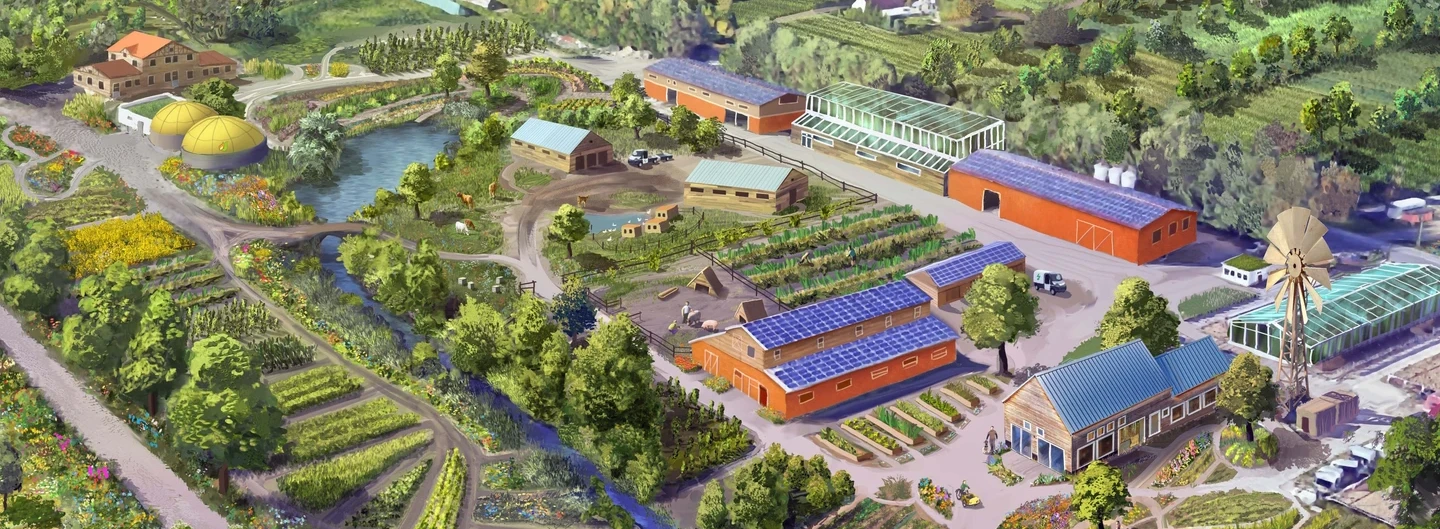
    Image: Country Life Utopia 2048, by Aerroscape

    Introduction

    Ideas for basic universal services (funding public / private to be determined).

    Based on the idea of solving my complete problem permanently (Lean Solutions).

    The blog is a bit of a ‘stream of consciousness’ for which I apologise but it was important to me to try to look at the whole problem of enabling people to live a meaningful life whilst taking the astronaut’s view of earth as a space ship which only has finite resources that must last the whole journey; if the human story on earth is to endure that means living within the constraints of nature including the ability of nature to process our waste including CO2.

    Shelter

    Definition

    Everyone needs a place to live.  The structure and its fundamental equipment needs maintaining, repairing and upgrading over time.

    Question of scope but as a minimum probably:

    1. Fabric of the building
    2. Maintain the inside of the building at a suitable temperature
    3. Water and sewerage (although the latter may include dry toilets, grey water etc)

    Current state

    Too much of salary devoted to basic fabric (relative to actual housing stock, replacement rate, growth in households, maintenance required etc).  Housing not aligned to work leading to excessive commuting and individual car ownership.

    Future state

    Zero land cost for residential housing. Residential land community owned.  Price controls related to replacement costs.  Shelter including heating and water and sewerage to enable trade offs (e.g. insulate versus provide energy for heat).

    Details to be work (e.g. exclude properties over council tax band E, only include certain amount of land and treat the remainder as potentially productive)

    Health

    Emphasis on maintaining health rather than addressing illness.  National Health Service rather than sickness service.  Including access to things that will maintain health.  

    Might want to include basic food service to allow trade offs between food and cost of addressing illness.

    Measure on both length of life and proportion of life lived in good health.

    Current State

    Spiral of decline as less money is directed at worst illnesses allowing more of these to develop.  

    Future State

    People have more ability to keep themselves healthy reducing burden on the sickness element of the system.  National basic food provision to address health issues created by food industrial complex.

    Sustenance

    Ability to obtain sufficient food (in terms of both calories and range of nutrients).  Again, people may be conditioned to want more than is reasonable within the constraints of climate emergency and need to reinvigorate nature.

    Current State

    Food industrial complex has people eating more food that is required (or healthy) and food that is unhealthy.  Much of health spending is related to poor diet.

    Future State

    Day to day diets are simple, consisting of less food, mostly locally grown and cooked from raw ingredients.  Food is still used for celebrations (e.g. Christmas) but less often than present.  Basic food provision as part of health provision.

    Food rules – Eat food, not too much, mostly plants

    Implement the recommendations in A Small Farm Future to enable UK to be largely self-sufficient in food whilst restoring 30% of UK to wilderness.

    If required, ration meat.

    References

    Food Rules, Pollan M

    A Small Farm Future, Smaje C

    Mobility

    Ability to travel when needed.  Problematic in climate emergency as desire and what might be considered allowable likely to conflict.  Need to look carefully at travel that adds most ‘value’ to society and people’s lives.  Need to try to reduce non-value adding travel.  Links to shelter and work.

    Old Age and Disability

    Ensuring that basic services are available to all independent of age and ability to work.  Neither of these conditions should negatively impact on people’s quality of life.  Work guarantee allowing people to work as much as they feel able.

    Broader Context

    Climate Emergency

    Current number one problem.  Everything needs to be measured against this problem.  Sophisticated multi-level models to enable choices to be made as to where CO2 budget should be spent.  Focus largely on the ending of the burning of fossil fuels but also preserving forests, improving soil quality and restoring oceans (don’t know much about the last one!).  However, other measures where they aren’t too risky (e.g. painting roofs white to reflect the sun), planting trees in towns and city for shade.  Preventing spread of deserts etc.

    Pressure on Nature

    Only just behind climate emergency and inter-linked.  In particular, need to reforest in order to drive precipitation and cool the earth.  Emphasis on pollinators.  Wildlife corridors.  Short term aim for UK 30% wilderness.

    Rise in inequality

    Decoupling of rise in wellbeing from GDP as early as the 1960’s in US.  Additional decoupling through neo liberalism and post 2008 financial crisis.  Proportion of GDP in wages falling etc etc

    Relationships between inequality and health and happiness.

    Future state

    Maximum 5 to 1 earning ratio between highest paid in organization and lowest paid (including all forms of income – salary, bonus, in-kind, dividends).

    Pressure on resources

    A response to climate emergency (fossil fuel burning) that depletes other resources and further destroys nature is not a sustainable one.

    Future state

    Doughnut economics.  Right to repair.  Banning of materials that cannot be recycled.

    Other fundamentals

    Politics and civil society

    Future State

    Return of local decision making.  NOTE: with modern communications this will lead to lots of ‘postcode lottery’ stories that will have to be dealt with.  Transition was difficult due to lack of experience of the population and lack of self confidence and feeling that ‘someone else should do this’ and I have a right to expect a ‘perfect life’.

    Compensation for possible failures in local decision making is layered planning models and measurements to understand which localities (at all levels) are off plan.  NOTE the plan is a democratically agreed plan (e.g. through referenda at different levels)

    Reference: Half-Earth Socialism, Vettesse and Pendergrass

    Equality

    Future State

    Modesty is valued.  People who make excess income are embarrassed and take steps to correct the situation.  

    National living wage set to ensure that a family can afford to live with 2 caregivers working 120% of normal hours.  Additional help for one caregiver families with children.

    Money

    Future State

    Money as information.  Money used to direct resources.  Money that sits still is taxed heavily so that it can be reused for the above. 

    Work

    Future State

    Work is available for those that want it.  Those that don’t do not have to work as long as they are not engaged in activities that are detrimental to others (understand that this is really hard to police!).  Work is rationed.  Industries that are destructive are stopped (oil and gas, casino capitalism).  Minimum wage is set at a level that enables a ‘decent live’.  Industries that are not able to pay these wages are allowed to perish (e.g. excessive hospitality).  Government picks up the slack addressing social issues (insulating homes, promoting health, providing arts and culture, restoring nature, climate friendly agriculture, recycling and restoring etc etc)

    Social life

    Future State

    Local low cost, no cost socializing is the mainstay.  Reduction in work and provision of basic services leaves people free to participate in a range of local activities (volunteering, sports, arts, social clubs, hobbies, life long education etc).  Driven by requirement for leisure industry to pay living wage.

    Capitalism and Profit

    Futures State

    Emphasis on small and local or large and non-profit.  If something can’t be achieved by a small organization then it should be done by a purpose based social enterprise.

    Government intervenes heavily in the banking sector to ensure that finance is directed towards productive enterprises.  Deconstructing of ‘money making money’ industries

    Global Trade

    Future State

    Requirement for government to balance imports and exports.  Government decides what sectors can import based on export performance.

    Very strict controls on flows of capital into and out of the country.

    Profit declared and taxes paid where business is done (end to excessive IP arrangements that export profits and avoid UK tax).

    End to foreign ownership of residential property (with reciprocal for UK people owning property overseas).

    Root Cause Problems

    Burning of fossil fuels and removal of remaining forests and other habitats that sequester carbon is making the planet uninhabitable by humans

    Injection

    No fossil fuels to be burnt by the UK.  Promotion of carbon sequestration overseas but not to get to ‘net zero’ but to restore CO2 levels to safe ones.

    Limiting of consumption of meat, fish and dairy with immediate ban on imports of these.

    Investment in UK agriculture to grow fruit, cereals, nuts and vegetables in UK using permaculture, agroforestry and high productivity agriculture (like Netherlands)

    Ban on import of products that lead to loss of vital habitats (e.g. palm oil)

    Current levels of consumption and waste are removing space for nature

    Injection

    Immediate 30% of UK left to nature

    Household model of the UK Economy

    Comparing the UK Economy to a household leads to poor decision making.

    Injection

    Move to a model of the UK Economy that recognizes:

    1. Government debt is not borrowing from external third parties; it is ‘borrowing’ using its own debt instrument.
    2. Focus decisions on government borrowing on the effect it will have on inflation.

    Stop using Gross Domestic Product (GDP) as a measure on performance of UK economy (society) and move the use of the Genuine Progress Indicator (GPI).

    Power Imbalance between Capital and Labour

    When private capital has more power than workers, then workers will be forced to accept jobs at wages that make profit for private companies but do not provide the workers with an adequate life-style.

    Injection

    Use a government job guarantee to establish a floor for wages in the private sector, ensuring that private companies can only make a profit whilst paying wages necessary to maintain an adequate life-style (e.g. based on the living wage foundation’s living wage)

    The wealthy command too many resources

    The wealthy command too many resources creating inflationary pressure before the modest needs of all workers are met.

    Injection

    Make income tax more progressive.  Set maximum salary multipliers within private companies.  

    Asset Inflation 

    Something about the ability to use scarce assets in lieu of income.

    Injection

    Tax unearned income (or unspent income) more heavily than income that produces an economic output.  Housing controls (see below)

    Excessive household debt

    Something about excessive household debt and viewing shelter (basic service) as a way to acquire wealth.

    Injection

    Debt jubilees

    1. Housing debt (mortgages) linked with control on future prices
    2. Higher education debt
    3. Others to be considered

    View housing as basic service.  Land designated as residential land as zero value.  Cost of housing related to build costs (or rebuild costs) at low carbon standard.  Additional land taxed at potential economic value based on surrounding land use.

    Private Pensions over State Pensions

    Leads to a desire to build up capital in property.  Pension companies tend to invest in financial products and assets rather than productive enterprises.

    The idea that the UK cannot afford to change seems odd when you realize that there is £6Tn in UK Private Pension funds.  

    By way of comparison:

    • £250bn to decarbonise residential properties
    • Onshore wind projects cost £1M per MW (UK needs 100GW or so of energy production)

    Specialization of the Economy

    Specialization makes the economy less resilient.   This will be a huge problem as climate change bites.  The country should attempt to be self-sufficient in the resources required to provide the universal basic services.  Given that the UK has few natural resources, this is likely to require the UK to need to adopt a reduce, reuse and recycle approach to key materials needed to deliver basic services.

    Trade Imbalances and other capital flows

    The UK economy exports productive work and pays for it by selling off assets.  Needs to stop.

    Must be a balance of trade based on:

    1. Maximising self-sufficiency with respect to food stuffs and raw materials 
    2. Fair trade of output of UK productive resources with those of other nations

    Capital flows are disallowed except in specific circumstances.

    Philosophical Root Causes

    Command over Nature

    Humans wrongly think that they can understand and command nature.  Nature is far more complex than humans realize and actions with respect to nature have consequences, many of which come to light years after they are taken.

    Injections

    1. A return to a posture of awe with respect to the beauty and complexity of nature; adopting the posture that nature cannot be tamed and humans must respect and live alongside nature.
    2. Presumption of harm whenever humans do anything contrary to nature (including but not limited to monoculture, releasing plastic into the environment, introducing non-native species etc)
    3. Immediate commitment to 50% of the planet left to nature (undisturbed) and 30% in the UK immediately given to nature.
    4. Move to agroforestry and permaculture to integrate human food production with nature (alongside things like Dutch approach to growing in glasshouses and (possibly) industrial production of protein – meat substitutes) to balance need to grow food with need to restore nature.

    Take what you want

    Education and marketing promotes the idea that every human can take what they want from the earth with no adverse consequences.  In this context ‘take’ include pushing the by-products out into the world (not just CO2 and other GHGs but also waste of all kinds).  It also means the depletion of nature resources that will not be renewed (metals, oil and gas etc).  

    Injections

    1. The default moral position should be to take as little as you can from the earth and no more than you need.
    2. Modesty as the default behaviour when faced with success.
    3. Education with respect to what people actually need to survive and thrive.
    4. Presumption against mass travel (or at a minimum fast travel)

    I have the right to be happy

    The next few decades are going to be tough.  People need to be resolved to this fact.  Happiness cannot be gained through life being easy and things being achievable through the mass deployment of non-human energy.

    Injection

    1. Happiness will be gained through the ability to enjoy the things that people really value (e.g. when asked at the ends of their lives what made them happy), such as relationships, experiences, learning, helping others.
    2. People will need to take pride in overcoming adversity together as a community

    I can be happy when those around me are not

    The idea that inequality does not impact on my happiness.  

    Injection

    1. Presumption that I will be happy when those around me are happy
    2. Presumption that my well-being and happiness cannot be at the expense of that of others

    Transition – The first five years

    Introduction

    We have five years to protect humankind from real misery due to the warming of the earth.

    Emergency action needs to be taken in that time to put the brakes on and buy time for permanent solutions.

    Demand Reduction

    In order to stop burning fossil fuels and slow the warming of the earth activities that rely on energy must stop.  Alternatives to fossil fuels will not arrive fast enough to save humanity from the effects of warming.

    Injections

    1. Immediate reduction in working hours (4 days at 7.5 hours per day with an aspiration to get to 4 days at 6 hours per day)
    2. 2 days per month of volunteering and 2 days per month of continuing education, sport, arts, hobbies (the one enabling the other)
    3. Working from home where possible
    4. Employers pay commuting costs with incentives to provide transport, enable use of public transport, including paying for commuting time over 1 hour per day (may have unintended consequences so care with this one!)
    5. Return to shorter hours for shops and entertainment venues (no later than 11pm, possibly earlier in the winter)
    6. Mass insulation of homes (no cost to homeowner).
    7. Free public transport with vehicle scrappage schemes.  Including innovations with respect to public transport like WestLink.

    Towards self-sufficiency in food

    The climate crisis is ultimately a food crisis.  The more the UK can be self-sufficient with respect to the food the more others can keep the food they produce.  This is likely to be forced upon the UK anyway as governments refuse to export food when they do not have enough for their own populations.   However, this will need to be achieved without adding to climate change through the wrong kind of food production.

    Injections

    1. National Basic Food Service to massively increase UK production of cereals, fruit vegetables and nuts.  Balanced between agroforestry, permaculture, small farms and industrial production.

    Towards self-sufficiency (or better) in energy

    Whilst the focus in the first five years will be on energy reduction, there are some quick wins with respect to energy production.

    Injections

    1. Community energy companies with simple access to the national grid.  National grid focussing on grid balancing.
    2. Add an additional layer of local grid balancing (micro-grids) around substations including energy storage.
    3. Nationalise residential energy and price controls such that investments can be made in decarbonizing home energy without the homeowner needing to pay.  Ability to provide district heating schemes to whole communities.
    4. Research into medium term solutions, in particular year round energy storage (at electricity, hydrogen or heat).
    5. Reverse ban on onshore wind.  
    6. Much faster planning permission for emergency schemes (e.g. district heating)

    Discourage energy use, nature and resource depletion

    Beyond energy for commuting and heating homes, other forms of energy use (and depletion of nature and finite resources) will have to be discouraged.

    There are two possible mechanisms – price or rationing.  The expectation would be that during the transition, rationing would be used to ensure that (say) 80% of resources are rationed to ensure fair access for all and the remaining 20% would be priced to encourage alternatives to be found.  

    This would require lots of modelling and consultation but this will have to be done in the first year of the emergency powers being granted.  Areas subject to rationing and price controls would include:

    1. Air flights – priority could be given to family visits, education, government business, NGOs and (some) business use for example with presumption against pure vacations.
    2. Fast fashion – priority given to sustainable clothing, limited number of new garments per person per year.
    3. Meat and Dairy – ban on imports from producers that deplete nature (e.g. Brazil stock yards), rationing on limited UK production etc
    4. Staples – gradual reduction in imports of staple food stuffs (e.g. cereals) and replace with UK production.  
    5. Tea, coffee and chocolate – ration to encourage countries to change land use to produce food for their own populations (and as production is hit by climate change)
    6. Food importing by National Basic Food Service with food re-priced to enable local food production.

    How will this be paid for?

    There will be a concern that this needs to be paid for.  However, it needs to be resourced, which is not the same thing.  The government (ideally all party) will have to direct resources during the critical first five years to ensure change happens fast enough.

    Injections

    1. All Party government for five years (led by the party that wins the next generation)
    2. ‘COVID’ style committee to hold the government to account
    3. Regular briefings to the country on progress
    4. Adoption of emergency powers to direct production to where it is needed (safe climate factories)
    5. Economic modelling to predict where money will flow and accumulate
    6. Actions taken to remove money from the economy which could be inflationary (based on analysis of where money flows to)

    Messaging

    What we oppose 

    Simple moral language to try to unite single issue campaigners under a common purpose.

    We OpposeCan cover and unit the following
    GreedDesire for excessive wealth
    Land reform
    ExploitationDiversity, gender, race, sexual orientation
    Of natural resources and nature 
    Of the poor by the rich
    Of the global south by the global north
    Power imbalances in decision making
    Of wealth and assets (rent seeking)
    WantHomelessness / poor housing, food and energy poverty, low wages, health, disadvantage through disability
    IdlenessLack of opportunities to work, learn, and enjoy leisure, sport and culture

    …and therefore what we stand for

    We stand forWhich can cover
    RestraintModesty, restraint, rebalancing (of prior greed), reduce, reuse, recycle
    CourageFairness, courage (to oppose exploitation), reparations (prior exploitation), participatory justice
    SupportEnough, self-sufficiency, resilience
    MeaningMeaningful work, educational opportunities, leisure, sport and cultural opportunities, 4 day week, decentralisation away from South East, reshoring, self-sufficiency, resilience, participatory democracy

    … Expressed as rights and obligations

    I have the right…

    To expect a life filled with meaningful opportunities to work on behalf of my community, learn knowledge and life skills, enjoy time with friends and family and participate in sports and cultural activities.

    To be supported in meeting my basic needs for shelter (including warmth), food, travel and wellbeing (including physical and mental health)

    In return I will…

    Show restraint in everything I do, in particular only taking from the earth that which can be replaced to ensure that future generations are able to thrive.

    Show courage ensuring fairness in all my dealing with others in my community and across the globe and participating on decision making and the delivery of justice in my community and across the globe

  • Degrowth – Lessons from escaping Stockholm Syndrone

    The Ragged Trousered Philanthropist Twitter account posted something recently that set me thinking. The post said “The saddest thing about England is the people should be up in arms. Instead there’s a national Stockholm Syndrome. Dumbed down through a diet of media propaganda, junk tv and jingoistic bullshit.”

    It really resonated withme, so I decided to see what lessons might exist in Stockholm Syndrome for those of us who see degrowth, MMT and resetting capitalism as means to address both inequality, exploitation of the global south and the climate emergency.

    What is Stockholm Syndrome?

    “Stockholm syndrome is an emotional response. It happens to some abuse and hostage victims when they have positive feelings toward an abuser or captor. “(WebMD)

    Some of the characteristics of Stockholm syndrome and how it arises certainly do appear to explain the lack of protest that is seen in capitalist and neoliberal countries.

    • A person might be abused and severely threatened by a captor or an abuser, but they also rely on them to survive. If the abuser is kind in any way, they might cling to this as a coping mechanism for survival.
      The depressing of wages and the draconian benefits system certainly leaves many in advanced economies (in particular US and UK) entirely dependent on governments who cling on to austerity as a policy and corporations who maximise shareholder returns at the expense of other stakeholders. If you cannot accept that a government that issues its own currency should be concerned about ‘deficits’ when the nation has not achieved full employment (in the terms defined by Willam Beveridge – See my previous blog) and if you cannot accept the Friedman doctrine that shareholder returns should be maxised to the detriment of other stakeholders including employees then you might reasonably see governments and profit maximizing corporation as captors or abusers. In a system where all means of production are subject to private ownership, where intellectual property rights are defended and where self-help and community action have been eroded, escape is not a realistic action. In a system where during a global pandemic the wealth of billionaires rockets and already poor people take on more debt to survive and where the difference in life expectancy between the most and least well off is 10 years the abuse is real.
    • People who have this syndrome seem to have common symptoms, including embarrassment about their emotions toward an abuser, confusion, guilt, difficulty trusting others an Post-traumatic Stress Disorder.
      These characteristics can be seen playing out in society. The pride that the working class historically maintained inspite of challenging conditions is barely visible in today’s neoliberal societies as the populus becomes less abd able to act – individually or as a community – and more and more dependent on their captors and abusers. The division between personal, family and community life that used exist and which the state and capitalists were unable to invade – a division created by a clear distinction between the working day and the non-working day, by unions and other community based organizations, and by a culture of self-made leisure – has all but disappeared. The ‘open all hours, 24/7, zero hours culture’ means that a person’s leisure time is not truly their own. In addition, what leisure time as does exist has been appropriated by the captor (whether through the mega pub, take away, or global or national TV or media).
    • People who this syndrome will adopt the manner and doctrine of their captors and abusers. During World War II, Austrian psychotherapist Bruno Bettelheim described several cases in which prisoners appeared to identify with Gestapo guards through both their behaviour and attitudes. Bettelheim described the camp as a laboratory that turned “free and upright citizens not only into grumbling slaves, but into serfs who in many respects accept their masters’ values.”
      Having grown up before Margaret Thatcher, I would argue that the period since 1980 has turned the UK into a laboratory that turned “free and upright citizens not only into gumbling slaves, but into serfs who in many respects accept their masters’ values” (in this case neoliberal governments and profit maximising capitalists)

    Escaping Stock Syndrome

    According to GoodTherapy you have to understand Stockholm syndrome in order to help someone who has it.

    • Try psychoeducation – teach victims of Stockholm syndrome what is going on
      How can the parties of the left educate whilst avoiding the pitfalls described in the remaining points? Can community based education, unions, arts and popular culture start to show the abuse that is happening in a way that allows people to understand what it going on and that they are being abused not looked after and that the ‘crumbs’ of good behaviours do not compensate for the bad behaviours and that change and not waiting is the best response.
    • Avoid polarization – don’t try to convince the victim of the villainous traits of the abuser; this may cause the victim to polarize and defend the perpetrator.
      This feels like the most important lesson given Brexit and the recent loss of labour seats in the red wall. This may go someway to explaining why so many people who appear to be victimised by the current system have been voting tory in increasing numbers.
    • Don’t give advice – victims need to make their own decisions.
      How can the parties of the left provide avenues for victims to make decisions that steer them out of the situation that they are in? How can cooperatives, mutual aid groups, self-help provide avenues that allow people to disengage from the abusive systems that have captured them?
    • Listen without judgement but use the Socratic method. As victims ponder what has happened listen and use reflection to show concern and validation and ask the victims questions about how they see the situation and how they feel and think and what they believe needs to happen next.
      How can the parties of the left engage with the victims, meeting them where they are and allowing them to find their own way out whilst providing paths for victims to follow as they start to recognise the abuse and look for a way to break free from their captors and abusers.
    • Address the cognitive dissonance – a victim’s intuition has been damaged and the may be confused about reality.
      The parties of the left need to encourage the victims of the system to trust themselves when they feel that ‘it doesn’t have to like this’. As they show signs that they understand that they are not the causes of their problems but victims; that if the abuse were to be removed they are capable of living a different and better life we need provide signposts to an abuse-free future.
    • Identify the “hook” – victims may over-identify with the perpetrator in a dysfunctional way in order to fulfil a personal need.
      Once the victim understands why they are so committed to the relationship, they can start making positive changes. How can the left help people to fulfil their needs outside of the system that is currently abusing them, through activism, or community action so that they realise that they have agency and can take responsibility for the fulfillment of their own needs.

    A tricky tightrope to walk

    I want to thank the Ragged Trousered Philanthropist for their thought-provoking tweet. As a thinker, I tend to respond to a situation by searching for a solution and persuading others to follow. When viewing the current plight of many people in modern society through the lens of Stockholm syndrome it is clear that this could be counter-productive.

    I will continue to reflect on this new perspective and its lessons for a left that must admit that many of the voters that have been lost to the left over the past three decades may now be suffering from a form of Stockholm syndrome as they have been captured by profit driven capitalism and austerity and ‘fallen in love with’ their abusers as the only means to rationalise what has happened to them.

    Final Thoughts

    I started this blog talking about degrowth, MMT and resetting capitalism but as I researched Stockholm syndrome, the more I recognised that these solutions will never come to pass until the population can be helped to recognise their capture and abuse and fall out of love with their captors and abusers. At that point, the question of what comes next can and must be addressed. And we don’t have much time to set the people free and find a new path.


  • A simple model of economic flows

    In this piece I am going to introduce a simple model of economic flows. This is by no means new or novel but something I put together as a way to think about contemporary problems in society. I apologize in advance that it is very simple and I am sure there are better models out there but putting it together helped me to organize my thoughts and I share it with that in mind.

    I have deliberately left out the Bank of England and flows of money in and out of the country although I hope to come back to these in the future. Therefore, it is a simplification but then ‘all models are wrong but some are useful’. I hope this is useful.

    A simple model of economic flows in a closed society

    The basic financial model

    Starting at A. Parties undertake activities that have an economic aspect. The parties could be individuals, organizations or other collective activity, or they could government departments who undertake work and are in receipt of money currency from the treasury (or who receive other kinds of funds such as fees from service users). The parties spend and receive currency either in the form of cash or via the financial system. The activity results in the movement of currency between parties and no net change to the amount of currency in the system.

    The parties might also receive currency in two other ways.

    1. They receive grants or benefits from the government (including government agencies or local authorities who disperse money).
    2. They receive currency in the form of loans or credit from financial institutions.

    The parties might disperse currency other than to another party as either:

    1. Payment of taxes or other government levy or duty.
    2. Repayment of amounts previously loaned by a financial institution.

    At this stage there is no net change to amount of currency in the system.

    Therefore, how does currency enter the system.

    1. The difference between the currency flowing out of the part of government that disperses currency to be spent by government departments, agencies and local authorities and the currency flowing into that part of government represents either new currency created or currency destroyed (B).
    2. The difference between the currency issued by banks as loans and credit and amount received by bank as repayments represents either new currency created or currency destroyed (C).

    Therefore the amount of currency in the system represents the difference between the amount issued by government in the form of benefits and grants and to be spent by government departments, agencies and local authorities and the amount recovered by the same in taxes, duties and other levies (so called “government debt”) PLUS the difference between the amount loaned by financial institutions to parties (including the parts of government that undertake economic activity) and the amount repaid to the financial institutions by the same (“private debt”).

    A number of observations can be made using the model.

    Everthing else being equal, economic growth must increase ‘debt’.

    1. The amount of economic activity can be measured by looking at the currency flows between economically active parties.
    2. The amount of economic activity will be a factor of many things but depends on there being sufficient stocks of currency sitting with non-government parties in the form of cash or bank deposits to enable one party to trigger economic activity from another through the payment (either in advance, at the time of, or at an agreed time after the activity occurs) and with government parties to trigger economic activity in response to non-government party’s need or decision making within the government party.
    3. These stocks of currency can only come from one of two places; the part of government that disperses currency or the banks.
    4. If economic growth is a goal of a society and all other things being equal for there to be economic growth there must be a growth in the stock of cash and deposits which in turn requires a growth in either “government debt” or private sector debt.

    Everything else being equal cutting public debt must must increase private debt.

    1. If economic growth is considered desirable AND public debt is considered undesirable then economic growth must lead to increased private debt since this is the only other source of addition stocks of cash and deposits to fuel economic growth.

    Non-financial aspects

    The remainder of the model looks at the non-financial aspects of the activities undertaken by the parties.

    Activities undertaken by the parties will impact on the well-being of the parties themselves and / or the other parties involved in the activities. Government activities are often specifically designed to improve the well-being of other parties, for example by providing health care or education, or may be designed to mitigate risks that if they mature would deplete well-being, for example by promoting good health, or by preventing crime. But activities undertaken by non-government parties can have the same effect, for example by providing opportunities for leisure, cultural enrichment or other activities that promote well-being like fitness classes or providing opportunities to socialize.

    In addition, the undertaking the activity may improve or deplete well being by providing income but also enjoyment and pride in work or conversely failing to provide an adequate income or by providing insufficient enrichment. Similarly, whilst benefits might provide a stock of currency that allows a party to avoid want, the amount may be insufficient to allow the individual to make good choices about how to use the currency leading to a depletion of well-being and the accompanying lack of meaningful activity in the form of work or the activities that an income derived from work can provide may itself deplete the party’s well-being.

    Many forms of activity either take resources from the natural world to enable the activity to occur or to be converted by the activity into stocks of man made resources, thus depleting the natural world. Similarly, many activities pollute the natural world depleting its ability to recover and restore itself. A small number of activities might actually build up the natural world or increase its ability to absorb waste and make it harmless.

    Most economic analysis fails to account properly for the true impact of converting the natural world into man-made resources (for example cutting down rain forests to farm cattle or grow palm oil), the value associated with the well-being of the parties in the systems and the depletion of the natural world, including its ability to absorb the waste produced by the activities undertaken by the parties in the system including the production of C02 and other greenhouse gases.

    Conclusion

    In this piece I wanted to focus on presenting the model as a means to think about issues facing the world and did not want to stray into making recommendations or proposing policies. This is because I want the model to be able to be used by anyone irrespective of their political leanings to investigate and propose policies but respectfully asking them to examine the impacts of these proposals not just from a financial perspective but also in terms of their possible impact on well-being (other some or all of the parties in the system depending on their political outlook) and on the stock of man-made resources and on the natural world. Whilst it is not necessarily true, I would hope that most people will want to design policies that promote a future for the parties in the systems (our children and our grandchildren) and that opening up the model to include these additional perspectives will provide a useful tool to think about and evaluate possible policies and political philosophies.

  • We need a paradigm shift…. Now

    We need a paradigm shift…. Now

    I recently saw Richard Murphy’s summary of green economics, the Green New Deal and MMT. This can be found at https://www.taxresearch.org.uk/Blog/2020/06/13/the-old-and-new-economic-orders/ and is reproduced at the centre of the systems dynamics diagram below. Rod White’s comment on Richard’s blog and his response pointed out that the Old Guard are in control and the current progressive parties are obsessed with the ‘How are you going to pay for it?’ question.

    In this blog I am going to have a go at laying out a logical flow that reframes the argument. This is shown graphically below as a simple systems dynamics diagram. For each block you can construct a sentence which says, ‘if [input block 1] and [input block 2] then [block]’. The left hand side covers the Old Order and its consequences and the right hand side looks at the outcome of adopting the New Order.

    The Old Order

    The logic of the Old Order is as follows:

    1. If a lack of money constrains everything we do and people aspire to live a live free from want and idleness then we value money and covet it.
    2. If a lack of money constrains everything we do and people aspire to live a life free from want and idleness then we provide minimum support to those wo have too little money.
    3. If we provide minimum support to those who have too little money and we value money and covet it then there are huge variations in life experiences.
    4. If we value money and covet it and there are no physical constraints on what we can do as the planet is a free gift of nature then we create a consumption based economy
    5. If we create a consumption based economy (and there are 7 billion humans) then over time the ability of the planet to sustain human life is jeopardy.

    Even worse, there is a positive feedback loop where the huge variations in life experiences leads people to put all their energies into the acquisition of wealth and consumption to ensure that they are not in the left behind group relying on the minimal support provided by the system. And the purpose of consumption is only to generate money to avoid the possibility of falling behind with no societal purpose nor concern about the consequences for the planet and the survival of the human race.

    The New Order

    The logic of the New Order following from the fundamental assertions made by Richard is as follows:

    1. If we have all the money we need to do things that are possible and we can only do what is possible with the constraints of that a living planet can sustain and people aspire to live a life free from want or idleness then we develop solutions that maximize wellbeing of people and the planet. (Green New Deal)
    2. If develop solutions that maximize wellbeing of people and the planet then we delivery freedom from want and idleness and repair the planet.

    However, as Rod points out the Old Order will be hard to dislodge, so:

    1. If some people try to hoard money to continue to overconsume and we have all the money we need to do things that are possible then we use taxes to ensure people do not have too much money.
    2. If we have all the money we need to do things that are possible and we deliver freedom from want and idleness and repair the planet then there is no incentive to hoard and covet money.
    3. If there is no incentive to hoard and covet money and we use taxes to ensure people don’t have too much money then there are small variations in life experiences

    We now have a positive feedback that reduces the incentive to hoard and covet money we create a purpose based economy in which there are small variations in life experiences and where progress is achieved through common effort and whose benefits are enjoyed in common.

    A Manifesto for a Progressive Party

    Converting this logic into a manifesto for a progressive party produces the following.

    Our Purpose

    Our purpose is to create a society in which,

    1. Everyone can survive in comfort within the constraints that a living planet can sustain.
    2. Enjoying a comfortable life does not depend on a person’s ability or williness to work.
    3. Work is available to everyone who wants it.

    Our Strategy

    The progressive party implements the following policies to achieve the purpose.

    1. The Government uses Modern Monetary Theory to operate the economy.
    2. The Government creates sufficient money to deploy the necessary resources to achive the purpose.
    3. The privates sector can make use of resources not used by the Government within the constraints that a living planet can sustain.
    4. The Government provides work in support of the achievement of the purpose when work is not available in the private sector.
    5. No-one gets left behind with respect to basic services, education, health and fitness and access to cultural and leisure opportunities.
    6. Taxation is used to ensure that economy does not overheat and to ensure that individuals cannot get too far ahead in particular with respect to over consumption of scare resources (including releasing waste into the environment)
    7. The nation does not consume more than its fair share of the constraints (depletion of resources and production of waste)
    8. The nation works internationally to persuade other nations to do the same (including levelling up nations where the population are not able to survive in comfort)

    Our Programme

    Phase 1 focusses on operationalizing Modern Monetary Theory to deliver the Green New Deal and ensure that no one is left behind. Government creates money and deploys it in areas of the country where the people are not enjoying a comfortable life. Schemes are chosen based on the speed at which they can move the country to a position where it is respecting the constraints of (e.g. rewilding, reform of agriculture, converting existing vehicles to electric, on-shore wind, household solar and home insulation). In addition, phase 1 includes a revolution in well being in which self-care, life long education, work life balance and self-sufficiency are promoted as well as a promoting local and particpatory leisure and cultural life over passive consumption of elite sport and entertainment.

    Phase 2 implements longer term solutions developed in phase 1 (converting from gas to green hydrogen for heating and industrial processes, reform of work and transport to reduce commuting, restoration of soil health, hydroponics, elimination of single use plastics, circular economy for consumer goods). Phase 2 goes beyond ensuring that we only do what is possible within the constraints that a living planet can sustain and actively repairs the damage done by during the fossil fuel period.

  • The application of Modern Monetary Theory to provide freedom from Want and Idleness through bringing the required degree of urgency to tackling the Climate Emergency

    The application of Modern Monetary Theory to provide freedom from Want and Idleness through bringing the required degree of urgency to tackling the Climate Emergency

    I regularly re-read Full Employment in a Free Society written by William Beveridge during the Second World War.  Beveridge’s contention was that a government should ensure that there is sufficient total outlay (consumption) in the economy to provide full employment where full employment refers to freedom from both Want (material needs not being met) and Idleness (psychological needs not being met).  In this short paper I attempt to synthesise his ideas with those of Modern Monetary Theory to provide a blueprint for a post- Neo Liberal world in which the government generates full employment by addressing the crisis facing the human race due man-made global warming.

    BACKGROUND

    1. Consumption is the sole end and purpose of all production
    2. All members of the community shall be free from Want; that is they should have an income sufficient for a healthy subsistence – adequate, food, shelter, clothing and warmth along with opportunities for leisure and personal growth
    3. Idleness is not the same as Want, but a separate evil, which men[sic] do not escape by having an income
    4. For those who are capable, employment provides the means by which production is achieved which in turn supports consumption including consumption which ensures freedom from Want; employment also provides freedom from Idleness
    5. Money serves as a medium of exchange, as a store of value, and as a unit of account.
    6. As productivity increases the volume of production required to deliver the consumption necessary to provide freedom from Want no longer provides sufficient employment to prevent Idleness
    7. As productivity and idleness increases labour’s share of GDP decreases leading to an accumulation of wealth by asset owners (money as a store of value) and increased income inequality
    8. A government that issues its own money can pay for goods, services, and financial assets without a need to collect money in the form of taxes or debt issuance in advance of such purchases.
    9. A government that issues its own money is only limited in its money creation and purchases by inflation, which accelerates once the real resources (labor, capital and natural resources) of the economy are utilized at full employment;  this demand-pull inflation can be controlled by taxation and bond issuance, which remove excess money from circulation
    10. The emphasis since the 1970’s on shareholder primacy has led to a culture which prizes short term financial results and production over consumption and drives companies to sabotage customers, employees and the community
    11. To avoid catastrophe countries must drive to zero (or negative) carbon emissions as quickly as possible (10 – 20 years and not 30 – 40 years) and must make immediate progress not back end targets
    12. The technology solutions required to drive to zero or negative carbon emissions are known but not economic in the short run

    THEREFORE

    1. A primary responsibility of government shall be to ensure that all members of the community are free from both Want and Idleness (full employment)
    2. For those able to work employment shall be the primary way to ensure freedom from Want and Idleness
    3. When the employment required to ensure freedom from Want is not sufficient to ensure freedom from Idleness, the government shall generate additional consumption of products and services that provide benefit to the whole community sufficient to ensure freedom from Want and Idleness 
    4. The government shall issue its own money to fund the consumption required to ensure freedom from Want and Idleness
    5. The government shall use taxation and the issuing of bonds to prevent demand-pull inflation resulting from excess money circulating after the real resources of the economy are fully employed
    6. The government shall ensure that the consumption it funds through the issue of its own money shall be purposeful leading to a) freedom from Idleness, b) an increase in labour share of GDP and c) a reduction in income inequality; the consumption funded by the government shall include the provision of lifelong education, health and social care 
    7. The government shall use taxation and robust legislation to ensure that shareholders and executives are not incentivised to maximise profits at the expense of consumers or the community at large
    8. The government shall use the reversal of the growth of carbon and other greenhouse gases in the atmosphere to provide the consumption required to provide freedom from Want and Idleness; directly, through subsidies or by funding the learning necessary to allow alternative zero carbon technologies to displace existing carbon emitting technologies
  • Housing – the key that unlocks everything else

    Housing – the key that unlocks everything else

    Curing our addiction to house price inflation is the key to solving so many of the problems that we face as a society.

    An average three bedroom house costs £125,000 to build and will last 90 years. Most people who own their own home will do so from the age of around 30 and average life expectancy is 80 years. On this basis each generation should to sustain the nation’s housing stock each household should need to invest £78,000 on average. And yet the average price of a house is £228,000.

    The median disposable household income in the UK is £28000. If the household have a mortgage with a loan to value ratio of 90% then they would need to take a mortgage that is nine times the household’s disposable income. If the members household were able to get to a mortgage at an interest rate of 3% per annum they would be paying 50% of their disposable income in mortgage payments.

    And in spite of this we manage to convince ourselves that ever growing house prices are making us richer.

    What if we approach the whole thing with a different mind set. Shelter is only one of a number of fundamental needs that we have as humans and as such allocating 20% of our income to it seems to be a reasonable goal to aim for.

    On this basis, and assuming long run interest rates of 4% per annum an average house would need to cost £110,000 or approximately half of the current average. How could this be achieved?

    1. Half the value of every residential property in the UK
    2. Get UK financial institutions to write off half of all mortgage debt
    3. Compensate householders by issuing sovereign money (free of debt) to compensate for the loss in asset value with a re-imposition of limits on what this money can be used for
    4. Control prices and rents from that point onward.

    This would represent about a 10% write down in the balance sheets of UK financial institutions but allowing interest rates to rise would compensate them and lead to improved savings rates.

    House holders could apply for a revaluation of their properties but only if genuine value has been added (e.g. building an extension); normal decoration or replacing a bathroom or kitchen would not attract a revaluation.

    The revaluation might not be uniform across the country as the goal would be to eliminate situations where local people cannot afford to buy locally.

    Going forward all house prices would advance in line with the increase in median earnings. When a house is sold the house holder would get the current valuation for the house, any excess paid by the buyer would go to the government as stamp duty.

    The main drawback is how to continue to encourage house building when the scheme would effectively lead to negative land prices. Therefore, residential land prices would also need to be controlled so that they never exceeded that price that would be paid for the alternative non-residential housing uses possible in the area (be that industrial, retail or agricultural). Where necessary the government would step in to subsidise the acquisition on land for residential house building. This would be funded through the savings in housing benefit that would result from the resetting and controlling of housing prices. By my reckoning the £10B required to acquire land would no exceed the savings in housing benefit currently paid to people in work who would now be able to afford decent housing without the support of the government.

    One addition idea which I need to spend more time on would be to look at the Danish mortgage bond system; this would potentially provide a suitable investment for the current house holders who are issued with sovereign money leading to a long term housing market where house purchases are financed using money that has been saved in pension pots rather than created by financial institution as debt.

    There is definitely more work to be done on the detail of the scheme but for me, reform of housing is the key that unlocks so many other policies, particularly in this time of climate crisis. With the population less dependent on either large employers or the government to be able to put even an inadequate roof over their heads:

    1. People will have better choices with respect to taking time out from work to bring up their own children;
    2. People will be able to live and work locally; reducing the number of cars and the number of miles travelled reducing emissions of CO2;
    3. People will be able to make better provision for their old age which in turn will produce funds for investment in UK industry and provide the basis for a stable housing market in the long run.